


By: Morgan Chilson
Kansas Reflector
TOPEKA — State decision-makers are mulling whether to drop Blue Cross Blue Shield of Kansas from the state employee health insurance plan, which would give employees just one option and potentially save the state nearly $240 million over three years.
Members of the Kansas State Employees Health Care Commission questioned representatives from Aetna and Blue Cross at an April 15 meeting, weighing proposals to administer the state’s health insurance plans for 43,400 eligible employees.
The proposals came in with a cost difference of about $240 million for the three-year contract, which would begin Jan. 1, 2027. That is the cost savings between going with the current set-up, which includes both companies, and going with just Aetna’s Local Best plan.
Costs for Blue Cross alone would be just over $1.5 billion, while Aetna, which offered two separate plans, came in at $1.4 billion for Aetna Choice POSII and $1.3 billion for Aetna Local Best.
If the state continued with both companies, combining Blue Cross and Aetna Local Best, the cost is just under $1.5 billion.
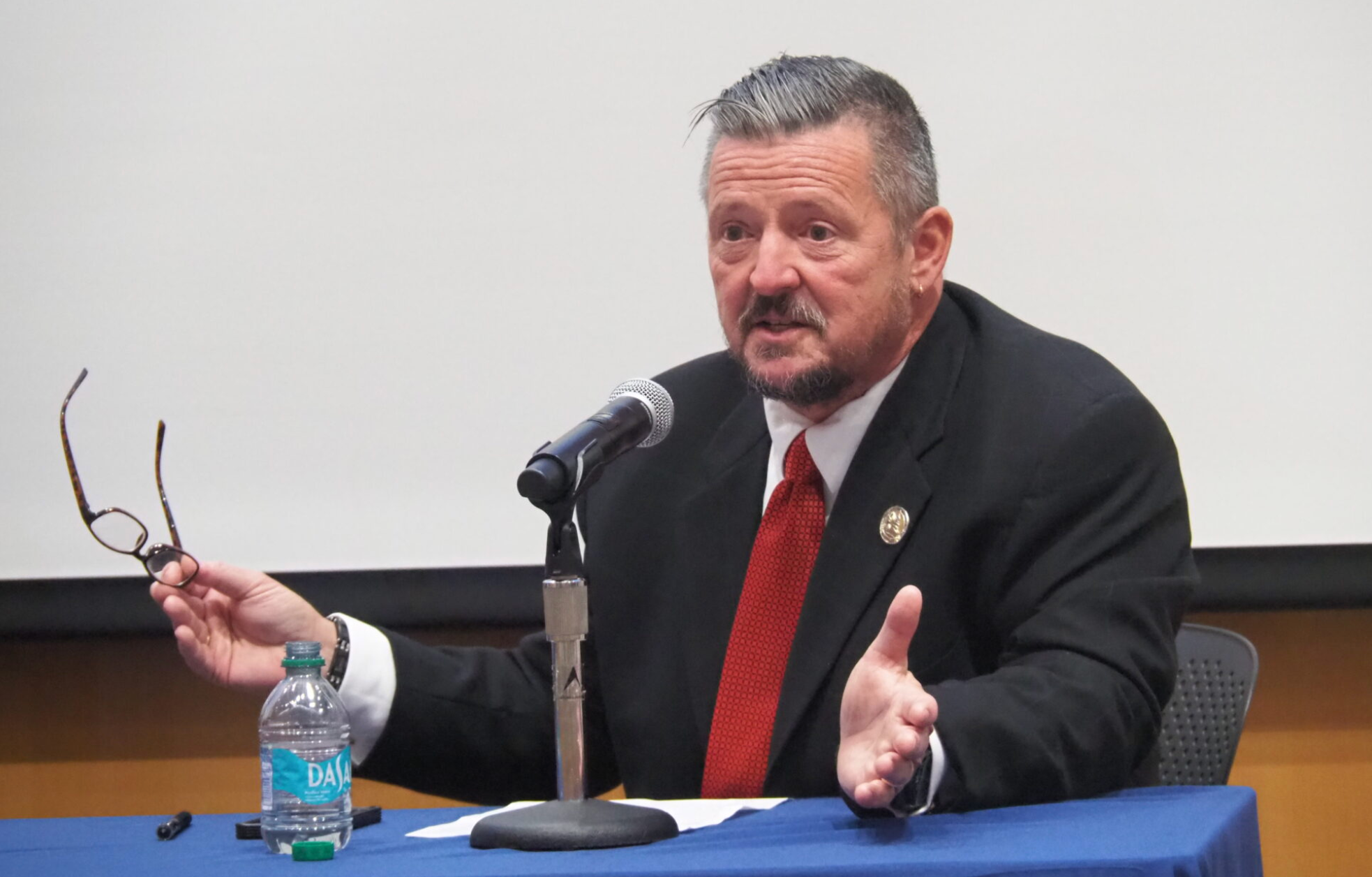
Rep. Bill Sutton, a Gardner Republican who serves on the commission on behalf of the House Appropriations Committee, said he was willing to go with Aetna based on the cost difference between the two plans.
“I’m a dollar and cent guy,” he said. “We have the responsibility to our plan members.”
Other commission members were hesitant to make a decision, asking for more information and clarification on the differences between the two proposals. They expressed concerns about the Aetna provider network, particularly in rural areas.
They are expected to decide in May after the companies submit additional information.
Both companies were providers in the state’s 2026 plan, with 4,500 state employees enrolled in Aetna and 35,400 in Blue Cross. Commissioners questioned the disruption that could occur if all Blue Cross enrollees must switch insurance and whether Aetna’s provider network would be adequate.
Cristi Cain, a Kansas Department of Health and Environment employee who represents state employees on the commission, said she was concerned employees won’t have access to needed medical care under Aetna’s network, pointing out that many people have used Blue Cross “for all of time.”
Blue Cross has been a provider of state insurance for at least 40 years, a company spokeswoman said.
“I have a team of people who are based across the state, and I know that they already have problems accessing care,” Cain said. “I don’t want to make it more difficult for state employees to access care.”
Blue Cross’ ancillary network had “notably higher” penetration in all regions than Aetna, said Jennifer Flory, director of the State Employee Benefits Health Plan. Ancillary services include diagnostic imaging and lab work, physical/speech/occupational therapies, home health, hospice, and skilled nursing, a commission report said.
In the southwest corner of Kansas, Aetna covered just 28% of ancillary services in its network while Blue Cross covered nearly 80%.
Overall, Aetna’s network had a higher penetration, primarily because of the large population in and around the Kansas City metropolitan area, a commission report said.
In some areas, such as physicians and specialists, the two companies were nearly equal in their coverage, although there was confusion about which specialities and providers were covered in various categories.
Insurance Commissioner Vicki Schmidt expressed frustration with the way the request for proposal was written because it wasn’t always clear what was included in each category, and she wanted to ensure they were comparing the bids properly.
An Aetna official at the meeting said the company would begin building out its provider network immediately, and commissioners discussed adding monetary penalties to the contract if the company didn’t do so.
“The problem is, if it doesn’t happen, then we have state employees without services,” Schmidt said. “So the monetary (penalty) is nice to — as a stick, I guess — but I think the more important thing is just having ancillary services for our employees and their families.”
Increasing costs are projected to eat away at the state health insurance reserves. In 2026, the program is expected to lose nearly $31 million, leaving reserves at just $6.5 million.
In 2027, costs are projected to exceed revenue by $21.5 million, clearing out the reserves and leaving the program $15 million overdrawn.
Commissioners questioned why pharmacy costs had increased more than 9%, asking about the costs of supplying GLP-1 medications for weight loss to plan participants who had a body mass index over 35. The costs are expected to drive up the employee share of insurance as much as 13% in future years.
“When we start telling our employees that we’re going to have a 13% increase — after they get a 1% (pay) raise from the state — a 13% increase in their healthcare insurance to make the bottom line because GLP-1s have consumed millions — over $20 million in our plan — and we sat here and didn’t do anything about it, I don’t want to take those calls,” Schmidt said.
Commission chairman and administration secretary Adam Proffitt said previous discussions about changing GLP-1 policies in the plan didn’t result in a vote to make the changes, and that the commission discussed tightening policies in June.
“If you want to say we’re not going to do anything about it this entire plan year, we will be sucking air by the end of this time,” Schmidt said.
At its June meeting, the commission will look at plan design and changes that could be made to lessen premium increases for state employees. Flory gave examples of increasing co-pay limits and removing caps on prescription medications.