


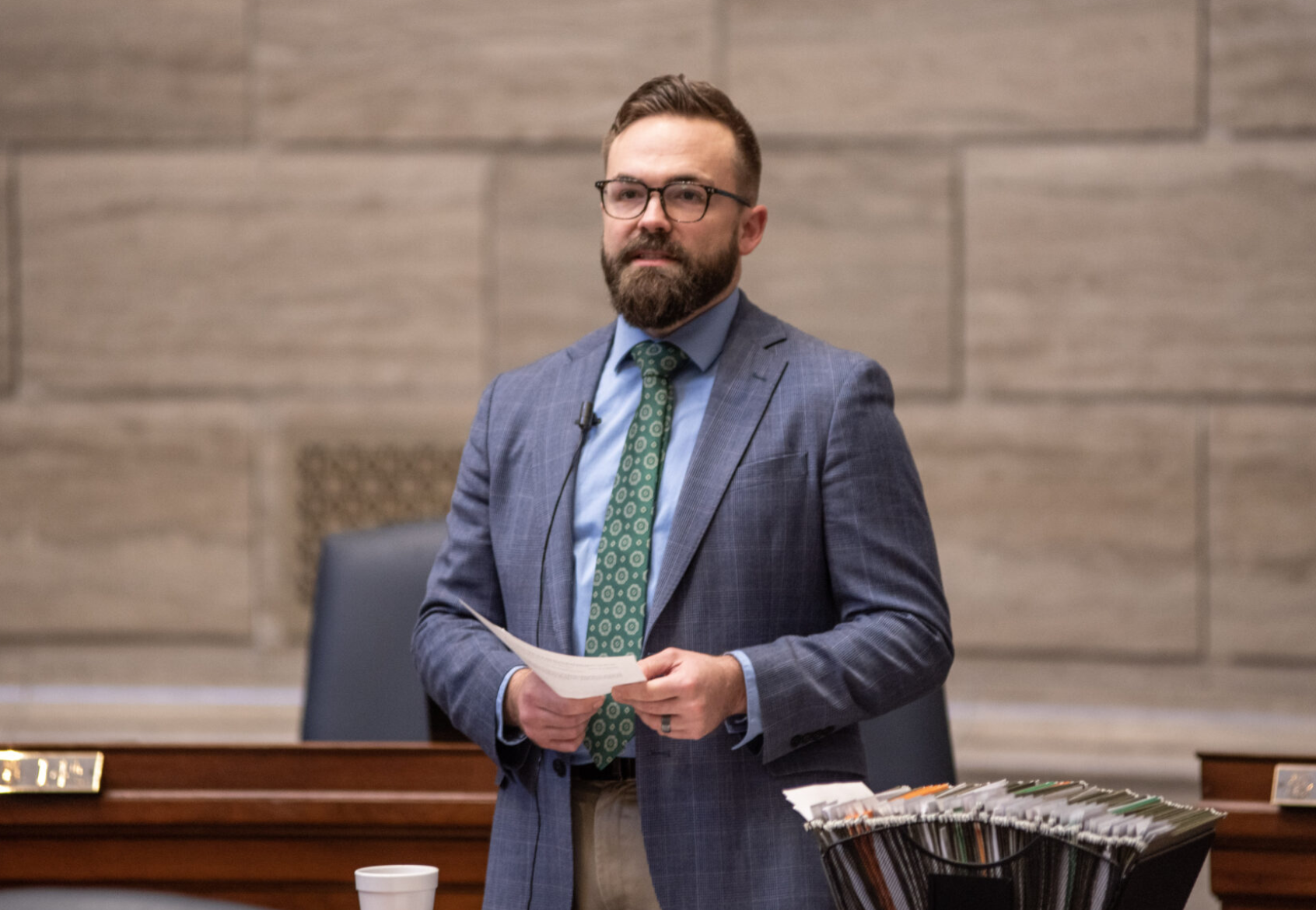
The initial legislation, sponsored by state Sen. Nick Schroer, would tighten restrictions on drones ahead of this summer’s FIFA World Cup games in Kansas City
BY: Steph Quinn
Missouri Independent
A bill to prohibit low-flying drones over power plants, pipelines and other infrastructure transformed into wide-ranging public safety legislation Tuesday as the Missouri House added 47 amendments over nearly three and half hours.
As the debate wore on, the bill became loaded with proposals ranging from a domestic violence registry to expanded DNA testing after arrests and altering pay policies at the state-controlled St. Louis Metropolitan Police Department.
The underlying bill, sponsored by Republican state Sen. Nick Schroer of Defiance, would expand the law that currently makes it a crime to operate drones over open-air stadiums or concert venues, reducing the minimum size of facilities where restrictions apply from 5,000 to 500 occupants and adding “critical infrastructure.”
The bill started the day at six pages. As House members prepared to vote on the final product, some speculated about its size — and whether the legislation they had rolled into the bill had gotten enough scrutiny.
“If I were a betting man, I would be very curious about the amount of pages that this new bill would be,” said Democratic state Rep. Marty Joe Murray of St. Louis.
Democratic state Rep. LaKeySha Bosley of St. Louis said some of the bills attached to Schroer’s legislation hadn’t previously been discussed by the House.
“There are a few bills on here that have never been vetted, that didn’t go through the committees, that didn’t have any conversations,” Bosley said. “The first time we had a conversation was on this floor, and only maybe one or two people even dove into the practicality of the bills.”
In the end, the legislation passed the House 83 to 61, with 18 Republicans and 43 Democrats in opposition, receiving just one more “aye” vote than needed to pass. The bill would need Senate approval to go to the governor.
Most of the provisions tacked onto Schroer’s legislation passed with little or no opposition.
One measure would make Missouri the third state, after Texas and Tennessee, to establish a domestic violence offender registry required for people convicted of two or more sexual assaults, felonies or class A misdemeanors against a family or household member.
Democratic state Rep. Raychel Proudie of Ferguson, one of the sponsors of the bill, said it would prevent repeat offenders from continuing a pattern of abuse.
“This session, we have done a tremendous amount of work for individuals who are survivors or who have succumbed to domestic violence,” Proudie said. “This continues that trend, making sure we are offering public safety options to all victims.”
Legislation sponsored by Republican state Rep. Philip Oehlerking of Ballwin would require the Missouri Department of Corrections to help inmates obtain driver’s licenses or state ID cards and records of their vocational training by the time of their release.
Oehlerking said the measure would help people find employment and reduce recidivism.
Democratic state Rep. Kimberly-Ann Collins of St. Louis added an amendment, based on legislation she sponsored with Republican state Rep. Jamie Gragg of Ozark, specifying that nonviolent offenders can earn “good time credit” toward their sentences for undergoing drug or alcohol use treatment, earning a high school or college diploma or vocational training certificate, or completing restorative justice.
“They will come out into society to reintegrate and hopefully become good tax-paying, law-abiding citizens,” Collins said.
Another amendment with little opposition would require drunk drivers who are convicted of killing a parent to pay child support for surviving children under 18.
But some of the amendments drew criticism.
A measure sponsored by Republican state Rep. Lane Roberts of Joplin would create the offense of “impeding, threatening or harassing a first responder” if someone goes within 25 feet of an officer or emergency medical provider after being warned not to approach.
While Roberts said the measure would protect first responders and bystanders, some lawmakers argued it would damage law enforcement transparency.
Democratic state Rep. Marlon Anderson of St. Louis said the discussion reminded him of the role of audio and video footage in the conviction of the Minneapolis police officer who killed George Floyd in 2020.
The final words spoken by Floyd in a video taken by a bystander were, “I can’t breathe.”
“But for that audio, that bad actor may have been [ruled] not guilty,” Anderson said.
Another measure, based on a bill filed by Republican state Rep. Cameron Parker of Campbell, would add to the list of offenses when law enforcement can collect DNA samples upon arrest. The additional offenses include drug possession and interfering with arrest.
Democratic state Rep. Elizabeth Fuchs of St. Louis said the legislation could “infringe upon the presumption of innocence.”
Anderson said it would disproportionately impact Missourians of color.
“I believe it’s going to start a fishing expedition for people who look like me,” Anderson said.
Several St. Louis Democrats decried an amendment offered by Republican state Rep. Brad Christ of St. Louis County that would alter language in the law that placed the St. Louis Metropolitan Police Department under state control last year.
Christ said the amendment would give flexibility to pay overtime to lieutenants in the department. It would also absolve the new Board of Police Commissioners from liability for actions by the department before it was created.
Bosley said the amendment was “absolutely asinine” and argued that it would violate the city’s local rights.
“You broke it,” Bosley said. “You fix it. You pay for it.”