


By: Tim Carpenter
Kansas Reflector
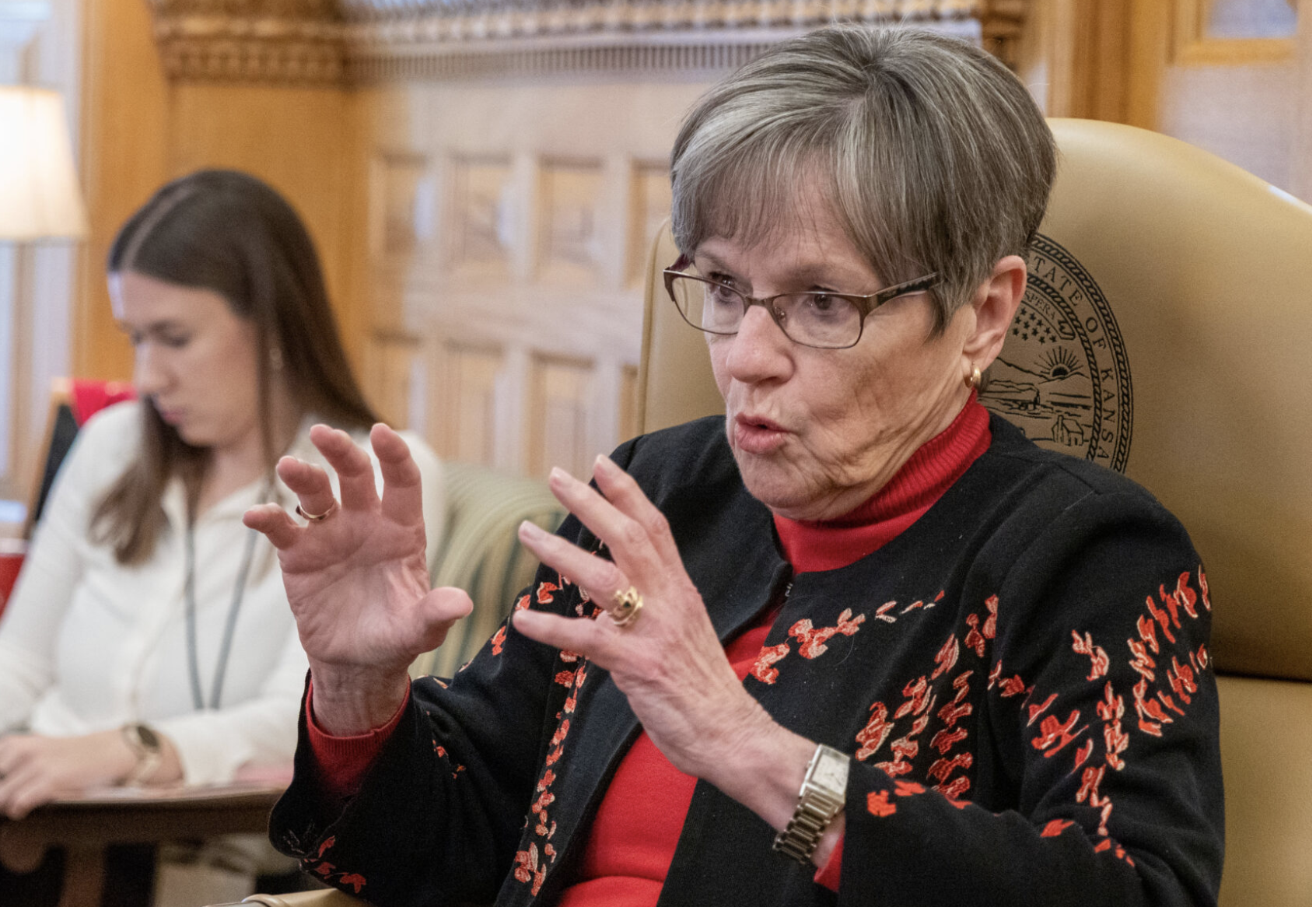
TOPEKA — Gov. Laura Kelly signed a bill enabling homeless veterans to be eligible for a non-driver identification card by the state of Kansas without charge and designating Aug. 7 of each year as Purple Heart Day in Kansas.
The legislation was part of a bundled bill about veterans affairs that was put together during the 2025 legislative session but not approved until the 2026 session. House Bill 2274 was unanimously passed by the House and Senate.
By expanding veterans’ access to ID cards, HB 2274 could help remove barriers to services, treatments or employment opportunities requiring a form of identification. The new law affirmed the state couldn’t charge a fee to homeless veterans eligible for the identification cards if the individual could verify military service with the Kansas Office of Veterans Service.
“This commonsense legislation is one way we can show our respect and appreciation for those who have served, while also making life a bit easier for veterans who are finding their footing upon return to civilian life,” Kelly said.
The ID portion of the bill was introduced by Sen. Oletha Faust-Goudeau, D-Wichita.
Under the Purple Heart provisions, Kansas would formally recognize individuals who earned the military decoration by being wounded or killed by enemy action in service of the U.S. armed forces.
Rep. Nate Butler, a Junction City Republican and retired U.S. Army major, said the annual Aug. 7 observance would reinforce the state’s reputation as a military-friendly state. The date reflects the Aug. 7, 1782, creation of the “Badge of Military Merit” by George Washington, who was commander in chief of the Continental Army.
“Kansas has always taken pride in the men and women who were either drafted or volunteered to defend our nation,” Butler said.
Kelly also signed a bill articulating the scope of practice for optometry under House Bill 2223, which was adopted 98-23 by the House and 34-6 by the Senate.
The governor put her signature to Senate Bill 348 to exempt not-for-profit, wholly owned subsidiaries of an public electric cooperative utility from jurisdiction of the Kansas Corporation Commission. The legislation was approved unanimously by the Legislature.
She signed Senate Bill 335, which would require that public construction contracts in Kansas include a waiver for claims of “consequential” damages, but not direct damages. The bill approved 37-2 by the Senate and by a margin of 84-34 in the House didn’t apply to private construction contracts.
Rep. Mike King, R-Hesston, said the objective was to have contractors and public entities sign a mutual waiver to block legal claims of indirect damages related to loss of future revenue, business, staff time, goodwill or reputation.
“These damages are difficult to predict and impossible to quantify,” said King, who was secretary of the Kansas Department of Transportation under former Gov. Sam Brownback.
Rep. Stephanie Sawyer Clayton, D-Overland Park, said the bill should have been rejected by the Legislature because its provisions didn’t put interests of taxpayers at the forefront.
“It removes an important legal tool that’s used to basically recover indirect costs incurred as a result of this contractor breach that costs taxpayers’ money. My duty lies with protecting the taxpayer,” Sawyer Clayton said.
The bill was endorsed by the Associated General Contractors of Kansas, Crossland Construction and the Kansas Department of Commerce, but opposed by the League of Kansas Municipalities and the cities of Olathe, Overland Park and Wichita.