


Poll also reveals deep indecision in gubernatorial and U.S. Senate campaigns
By: Tim Carpenter
Kansas Reflector
TOPEKA — A poll of Democratic and left-leaning independent voters completed seven weeks before the August primary places Cindy Holscher as frontrunner in the governor’s race and Adam Hamilton leading in the campaign to pick a nominee for U.S. Senate.
The poll of 1,000 Kansans was conducted by Change Research, a San Francisco company engaged with Democratic or progressive candidates and groups. The June 11-15 poll with a margin of error of plus or minus 3% was commissioned by Civic Clarity, a nonprofit operating the Capitol Bee news entity in Kansas.
The snapshot among registered Democrats and independent voters eligible to take part in the open Democratic primary revealed 44% had yet to declare a preference in the three-way Democratic governor’s race and 55% were at a loss in terms of the 11 Democratic candidates competing for the U.S. Senate seat held by Republican Roger Marshall, who is seeking reelection to a second term.
Holscher has been engaged in a campaign with fellow Johnson County state Sen. Ethan Corson, as well as newcomer Curt Skoog, who serves as mayor of Overland Park. In the survey, Holscher received 37% of support from participants while Corson possessed 10% and Skoog had 7%. Skoog filed as an official candidate at the June 1 deadline, while Holscher and Corson have been on the campaign trail since 2025.
Holscher campaign manager Madi Ashcraft said the senator’s message was resonating with primary voters because she was concentrating on education, health care and cost-of-living issues.
“While others are focused on maintaining the status quo, Cindy is focused on delivering results and putting people first,” Ashcraft said. “We’re going to continue earning every vote and building the campaign needed to beat the MAGA nominee in November.”
Glynnis Harvey, spokesperson for Corson, said the snapshot was taken before Corson made an advertising buy of nearly $1 million in the Wichita and Kansas City markets and before the first public debate of the Democratic primary for governor.
“Ethan is the only candidate with the resources needed to win in both August and November, having outraised the nearest competitor two-to-one in the last reporting period,” Harvey said. “Not only does Ethan have the resources to win, he has crisscrossed over 25,000 miles of the state, connecting with Kansans face to face about his message of fighting for Medicaid expansion, protecting abortion rights and standing up to (President Donald) Trump and ICE.”
Democratic Gov. Laura Kelly can’t seek election to a third term in 2026 after defeating Republican nominees Kris Kobach in 2018 and Derek Schmidt in 2022.
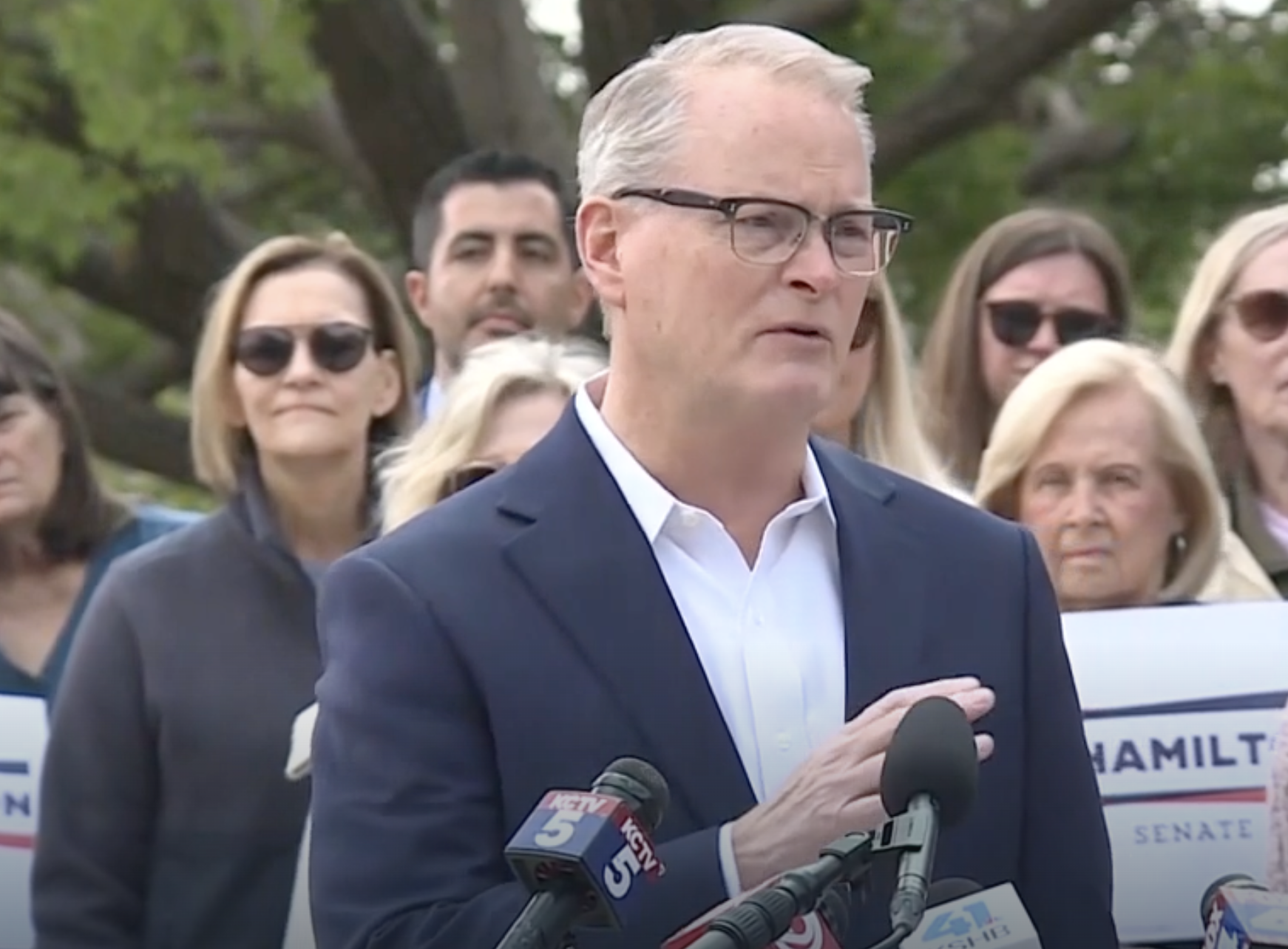
Hamilton, pastor of the Resurrection United Methodist Church in Kansas City, who entered the U.S. Senate campaign in late April, pulled in 18% of support among Kansans responding to the online survey.
Six other Democrats in the crowded primary field registered in the poll: Christy Davis, 10%; Patrick Schmidt, 7%; Noah Taylor, 4%; Anne Parelkar, 3%; Erik Murray, 2%; and Sandy Spidel Neumann, 1%.
“Kansans are saying we have to do better and it’s time to do something different,” said Tyson Brody, communications director for Hamilton’s campaign. “Adam will be a senator who listens to Kansans, works to lower costs and fights for all of us.”
Previous surveys in Kansas have been linked to candidates, but the independent Change Research poll offered a glimpse at two significant contests without campaigns placing a finger on the scale in terms of how questions were posed and answers were solicited from participants, said Bob Beatty, a professor of political science at Washburn University.
He said it would be best to follow with several polls to determine whether the outcomes were comparable to the Change Research effort.
“This poll is important. It’s a calm-before-the-storm poll,” Beatty said. “What we need to see is a poll in mid-July when the ad blitz has commenced.”
Beatty said it wasn’t unusual to have about half of voters undecided about their primary election preferences in mid-June.
In the poll, the top issue in terms of importance to the 2026 election was inflation and the cost of living, which was noted by 63% of respondents.
Here is the remainder of the top-10 issues in ranked order: defending democracy, 61%; healthcare, 53%; K-12 public education, 31%; climate change and environment, 31%; abortion, 29%; jobs and the economy, 27%; affordable housing, 23%; property taxes, 19%; and crime and public safety, 10%.
The poll of 1,022 likely Democratic voters had a heavy representation of women over men — 62% to 35%. The age demographic of those surveyed had 34% over 65; 20% were 50 to 64; 22% were 35 to 49; and 24% were 18 to 34. Nine percent had a two-year college degree, 31% had a bachelor’s degree and 27% had some form of graduate degree.