


A second emergency application to Justice Brett Kavanaugh seeks to block the decision of a St. Louis federal judge.
BY: RUDI KELLER
Missouri Independent
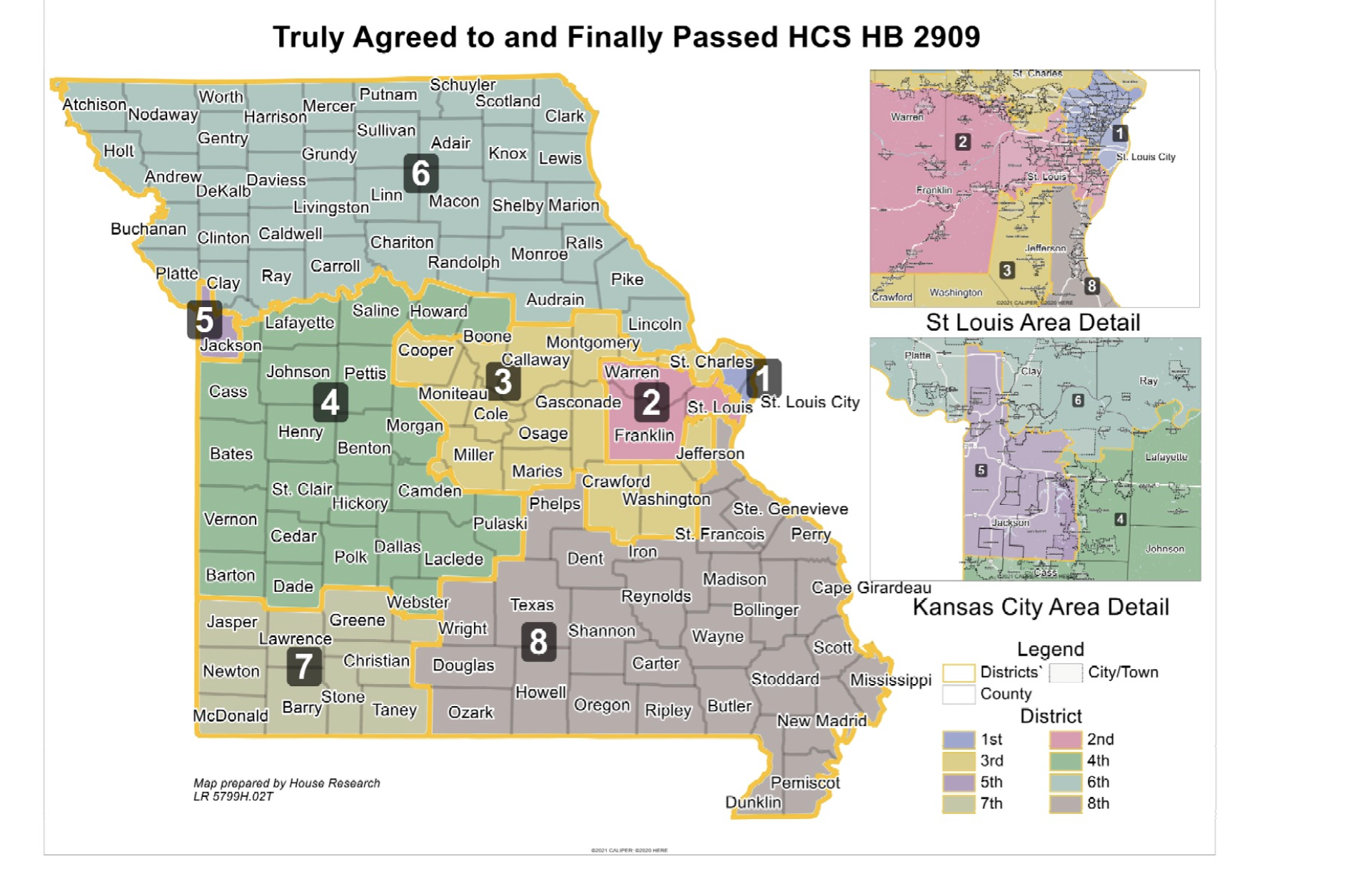
The question of which congressional district map Missouri will use in November returned to U.S. Supreme Court Justice Brett Kavanaugh on Wednesday after a federal appeals court refused to block an order requiring use of the Republican-drawn 2025 map.
People Not Politicians, the political action committee that forced a referendum on the map, filed an emergency application with Kavanaugh shortly after the Eighth U.S. Circuit Court of Appeals declined to stay a ruling from Chief U.S. District Judge Stephen Clark.
The application puts the dispute back before Kavanaugh less than 24 hours after he rejected Secretary of State Denny Hoskins’ request to block a Missouri Supreme Court ruling requiring the November election to use the state’s 2022 congressional districts.
“Minutes after Justice Kavanaugh denied a request to stay the Missouri Supreme Court’s decision in this redistricting case, a district court chose to deliver the relief this court withheld based on the exact same manufactured emergency,” attorneys for People Not Politicians wrote.
Since Kavanaugh delivered his decision shortly before 5 p.m. Tuesday, it has proven to be anything but final. Soon came Clark’s ruling that no map except the gerrymandered plan passed by Republicans in 2025 could be used for the election.
Clark’s ruling triggered a chain of events that came in rapid fire Tuesday evening and during the day on Wednesday that went on three tracks: one back to the Missouri Supreme Court, one to Clark’s courtroom in St. Louis and one back to Kavanaugh.
Secretary of State Denny Hoskins emailed his certification of the November election to local officials and to use the 2025 map because Clark’s order “takes precedence over the Missouri Supreme Court’s order.”
People Not Politicians asked the Missouri Supreme Court to find Hoskins in contempt. The court set a hearing for 10 a.m. Thursday and ordered Hoskins to be present.
Hoskins then asked Clark to order the Missouri Supreme Court to cancel its Thursday hearing. Clark had not ruled by 6:15 p.m. Wednesday.
While Clark weighed the state contempt allegations, the Eight Circuit Court of Appeals in St. Louis denied an application for a stay of Clark’s Tuesday ruling
Kavanaugh ordered Hoskins and the plaintiffs in the federal lawsuit — U.S. Rep. Bob Onder, state Sen. Rick Brattin and two voters — to respond by 9 a,n, Thursday.
Clark’s ruling creates a conflict that must be resolved, the attorneys for People Not Politicians wrote in the application to Kavanaugh.
“At no point in its discussion of either the merits or the equities did the district court mention — let alone explain its conflict with — the Missouri Supreme Court’s September 3 ruling and injunction,” the filing states. “Nor did the district court attempt to reconcile its decision with this Court’s denial of a stay application making identical arguments minutes before the (temporary restraining order) was issued.”
Kavanaugh can decide the question at any time. When he denied Hoskins’ application for a stay on Tuesday, he did not state his reasons.
While that request awaits action, the Missouri Supreme Court and Clark are being asked to decide what authority each court has over Hoskins.
“This court should bar the Missouri Supreme Court’s attempt to punish Secretary Hoskins for complying with this court’s order,” Lou Capozzi of the attorney general’s office wrote in the application to Clark on Hoskins’ behalf.
Hoskins blames Richard von Glahn, director of People Not Politicians, for his position stuck between two courts.
“Von Glahn’s motion is a blatant attempt to frustrate this court’s order,” Capozzi wrote. “Indeed, Von Glahn proclaimed that the Missouri Supreme Court should ‘make clear that regardless of other orders (except from the United States Supreme Court) the Missouri Secretary of State must comply with [the Missouri Supreme Court’s] injunction…Remarkably, the Missouri Supreme Court is taking Von Glahn’s motion very seriously.”
In the People Not Politicians response, attorney Jeremy Root wrote that Clark should not interfere with the Missouri Supreme Court proceeding.
“A state court conducting a contempt proceeding is not interfering with the federal court’s jurisdiction; it is exercising its own jurisdiction over its own case and its own orders,” he wrote.
And, Root argues, the Missouri Supreme Court is not a party to the case and the courthouse where it resides is not in the Eastern District, where Clark has jurisdiction.
“This geographic division creates a serious venue and personal jurisdiction issue,” Root wrote. “Even for an actual party to an action, a federal court must have personal jurisdiction.”
In the response to the Missouri Supreme Court asking it not to hold Hoskins in contempt, Capozzi argues that the state’s jurisdiction over Hoskins ended when Clark issued his ruling.
“This court’s order can no longer compel the secretary,” Capozzi wrote.
Clark’s decision came just before the deadline for fixing the ballots for November and was the operative decision, Capozzi wrote.
“So long as the district court’s order stands, the secretary must obey it,” he wrote.
The two cases argue unrelated points of law and therefore do not overlap, Capozzi wrote.
“The court must not,” he wrote, “take the radical step of holding the secretary of state in contempt for following a federal court order.”
In the final filing to the Missouri Supreme Court on whether to hold Hoskins in contempt, attorney Chuck Hatfield, representing People Not Politicians, said Hoskins had a choice that did not invite the contempt charge. He could have, Hatfield argued, taken no action on which map to use until every possible court had its final say.
“A plain reading of the two orders reveals that the Secretary can comply with both orders by doing nothing until he hears from a higher authority,” Hatfield wrote. “Instead he presents the false, binary choice between two orders rather than trying to, in good faith, comply with both.”
Hatfield cited a dozen instances when filings on behalf of the secretary have belittled the ruling, including accusations that the judges allowed personal feelings, rather than legal grounds, to influence their decision.
One was in the application that Capozzi wrote that led to Kavanaugh’s first decision.
“Reading between the lines, what seems to have driven the Missouri Supreme Court’s disinterest in federal law was its displeasure with the secretary’s processing of respondent’s referendum petition,” Capozzi wrote.
The court should do what it deems appropriate to enforce its order, Hatfield wrote.
“The court has broad discretion in fashioning relief, so long as the sanction is designed to compel compliance rather than to punish,” Hatfield wrote, “and Hoskins retains the ability to purge the contempt by obeying this court’s injunction.”