


The formula that determines state aid for public schools calls for an additional $110 million increase after lawmakers denied fiscal year 2027 boost
By Annelise Hanshaw
Missouri Independent
Missouri education officials are preparing to ask lawmakers for roughly $300 million more for public schools next year, setting up a potentially difficult budget fight as the state faces a projected revenue shortfall.
The numbers are yet to be finalized, but the Department of Elementary and Secondary Education’s preliminary report shows that recent changes to state law have driven up the cost of Missouri’s public school funding formula by $110 million in fiscal year 2028.
That comes on top of roughly $190 million that the formula called for this year but lawmakers did not fully fund with general revenue.
Because lawmakers also used about $100 million from other sources to cover part of this year’s school funding, the department could have to seek nearly $400 million more in general revenue next year to fully fund the formula.
The increases are largely dictated by Missouri’s school funding formula, which lawmakers created two decades ago and began reworking in 2024. The figures startled the State Board of Education during its meeting Tuesday.
Board member Mike Matousek, from Kansas City, said he worried about the optics of asking for money lawmakers refused to appropriate last year and an additional $110 million.
“This board and the department have a credibility issue with state lawmakers on the budget stuff,” he said. “It is hard for me to support a $400 million increase that not a single person in this room thinks we are going to get.”
Last year, the formula calculated a $190 million increase and lawmakers chose not to fund it. They kept funding flat, tapping into funds like the blind pension fund for $100 million of the formula call. Because this money wasn’t funded through general revenue, the department must ask again for it as a “new decision item” even if it isn’t new.
“We do realize this is a very large request, especially in this budget year, and we understand there will be questions about the likelihood whether that all comes to pass,” the department’s deputy commissioner of financial and administrative services, Kyle Kruse, told the board. “But there is also the viewpoint that the legislature has spoken in terms of how they choose to fund schools.”
The increase is coming from changes included in an education omnibus bill passed in 2024, including a shift in the way the formula counts students away from purely attendance-based funding to a split between attendance and enrollment numbers. This has been slowly phased in, with each year shifting 10% towards enrollment and driving the cost of the formula up $40 million annually since fiscal year 2026.
The 2024 law also gave an incentive for districts to keep a five-day school week as a growing number of Missouri schools switched to a four-day week. For the past two years, districts with at least 169 school days have received a one percent funding boost, which will jump to 2% in fiscal year 2028 at a cost of around $66 million.
These increases come as the state predicts a general revenue shortfall. The budget instructions published by the Office of Administration earlier this month warn against excess spending.
“Despite efforts to curtail government spending, the state faces a projected shortfall of more than $500 million in fiscal year 2028,” Dan Haug, the recently retired state budget director, wrote in the opening letter. “Ongoing general revenue spending authorized in the fiscal year 2027 budget is projected to outpace ongoing revenues by more than $1 billion and grow larger in future years.”
The document instructs departments to only ask for “mandatory” items. Kruse said this could be interpreted in different ways but that he sees it as a “narrow gate.”
Members of the state board had discussed ideas for budget requests, and the board’s finance committee chair, Kerry Casey, sent those for consideration. They included initiatives, like a $10 million grant program for struggling schools and an awards program to celebrate academic excellence at a cost of $50,000.
“A number of these items,” Kruse said “won’t make it through that gate.”
The board seemed hesitant to pursue these ideas under the budget crunch ahead, and there was some discussion of what authority the board had to pursue further cuts.
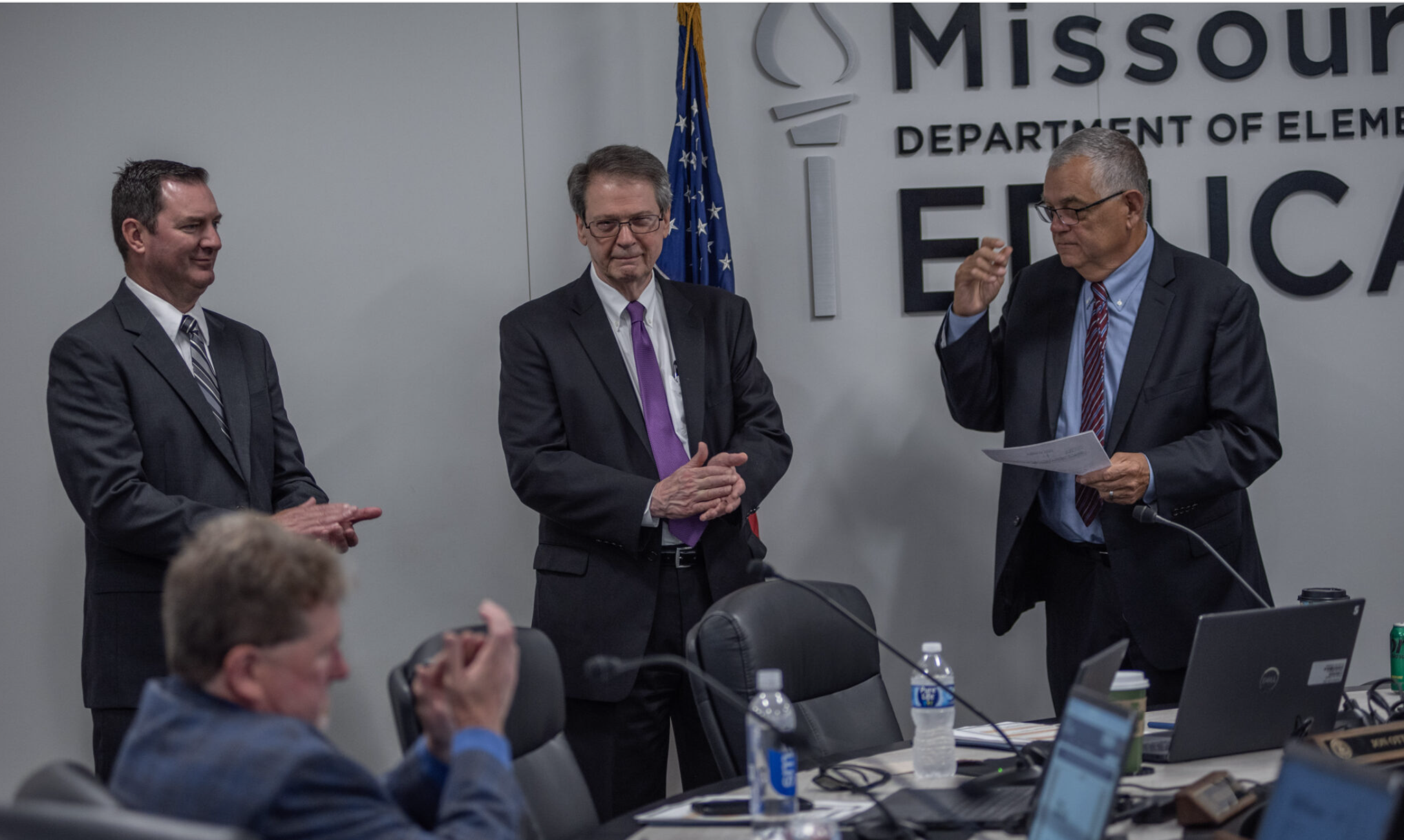
Board member Vince Schoemehl, who was sworn in as a new board member at the beginning of Tuesday’s meeting, questioned the longstanding practice of adopting the current budget as the basis of next year’s request. Schoemehl, who was the mayor of St. Louis from 1981 to 1993, said he worked with a base-zero budget.
“You start off assuming nothing goes from this year to the next year,” he said. “Everything has to be justified.”
Other items the department anticipates including in the budget request include a 3% increase in funding for student transportation and just over $7 million to implement Gov. Mike Kehoe’s executive order calling for “A-F” grade cards for public schools.
The department anticipates releasing a draft of the grade cards this fall using data from the 2024-25 school year as it works toward creating a report with last school year’s test scores. It has not received any funding for the current fiscal year for this work, so it is asking for $518,000 in a supplemental budget request.
Carrying out the plan next fiscal year is estimated to cost just over $6.5 million, Kruse said, including additional department staff.
The board plans to hold a second meeting this month in order to further discuss the budget under tight time constraints.
In recent years, the board has not taken such a detailed role in developing DESE’s budget. But with many members relatively new to the board, they have sought greater involvement in shaping this year’s request.