


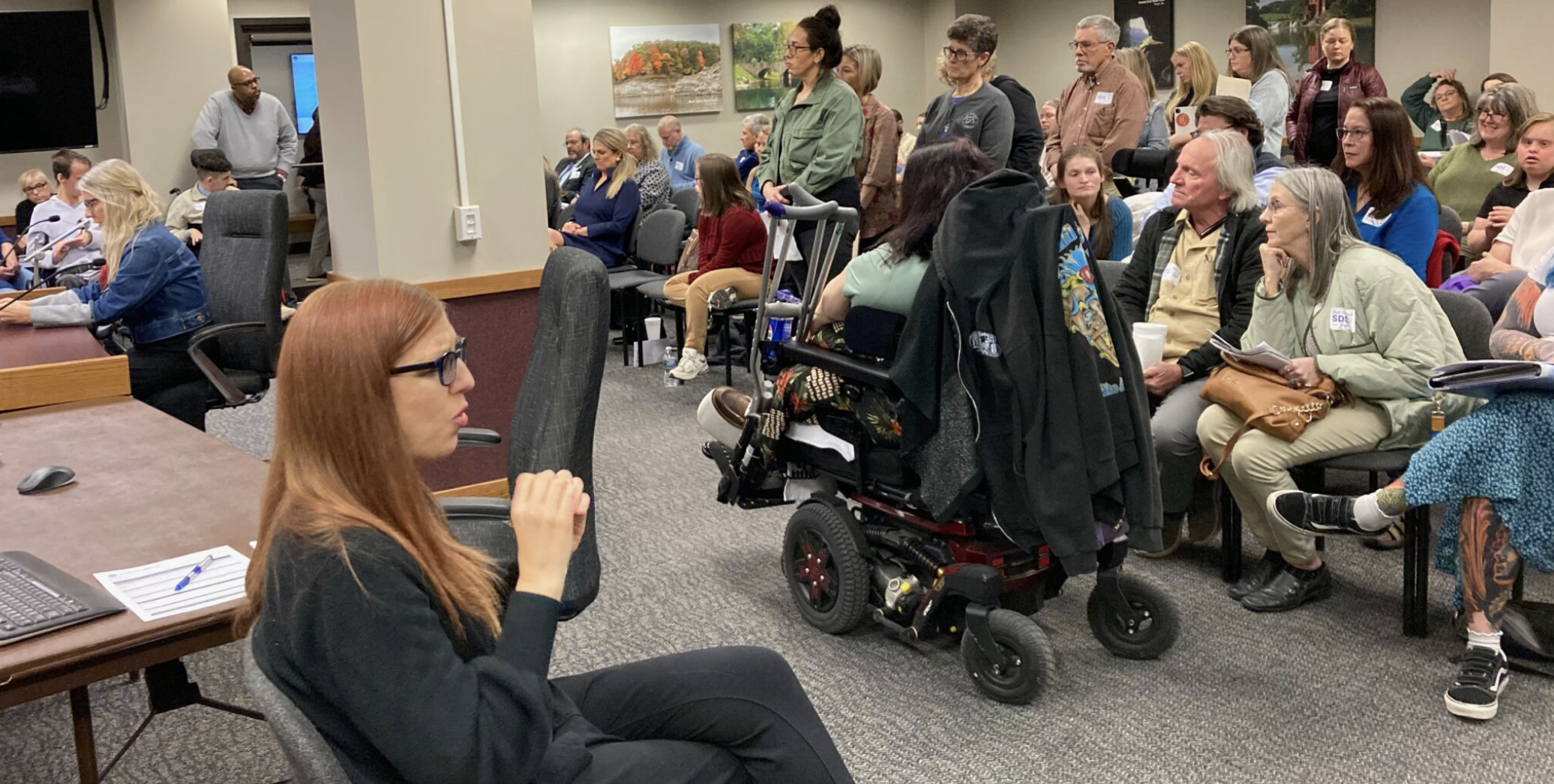
The proposed cuts came out of a ‘core reduction exercise’ requested by Gov. Mike Kehoe. Lawmakers from both parties vowed to undo the reductions, but warned the governor could still veto any restoration
By: Steph Quinn
Missouri Independent
Dozens of Missourians with developmental disabilities, their families, care staff and advocates packed a basement hearing room in the Capitol this week to oppose $80.7 million in proposed cuts to services that help people with disabilities live safely in their homes and participate actively in their communities.
One witness after another testified — to applause from the audience and tears from some lawmakers — that the proposed pay rate reductions of 21% to 29% would force care staff to find other work. That, in turn, could drive many disabled Missourians to seek care from agencies and institutions less attuned to their needs, or worse, where some worry they could suffer neglect.
The budget proposal put forth by Gov. Mike Kehoe would cut $28.6 million in state general revenue spending, and the state would lose almost twice as much federal match funding as a result.
Department of Mental Health Director Valerie Huhn also told lawmakers Tuesday that funding levels in the governor’s proposed budget could lead to a waitlist for new applicants by late summer or fall. Community residential placements could see waitlists by winter.
Lawmakers across the political spectrum promised to look for a way to restore funding for the services.
“Everybody in this room, on this dais, we are all fighting to fund this,” said Republican state Rep. Darin Chappell of Rogersville, who chairs the subcommittee covering health, mental health and social services. “I will do everything I can do to make sure that the fat elsewhere is cut before we ever touch dollars in this area.”
Republican state Rep. Mitch Boggs of LaRussell echoed Chappell’s pledge.
“We are listening. We are working on a solution,” Boggs said. “Collectively, the whole body, not just the budget committee.”
State Rep. Betsy Fogle of Springfield, the ranking Democrat on the committee, said responsibility for the proposed cuts lies with the governor.
“There is one person right now who has made the recommendations to cut these two items, and that person is the governor,” Fogle said. “Nobody in this budget room has suggested that we support those cuts.”
Running scenarios
The proposed reductions in disability care funding originated as part of a “core reduction exercise” that Kehoe requested last year, Huhn told lawmakers Tuesday.
The exercise asked departments to submit scenarios of various levels of cuts from their core budgets for fiscal year 2027 — a process a spokesperson for the governor’s office described in an email to The Independent as “a best practice for good budgeting” that prior administrations have also used.
Fogle asked Huhn whether the recommended reductions came from the department or the governor’s office.
Huhn said the proposed reductions were one of several options offered by the department and that one alternative they presented would have made a smaller cut.
“We presented a variety of options,” Huhn said. “That was an option that was selected by the governor.”
Huhn also said the department presented the options with the intention of “build[ing] some equity in the rate structure” for staff across settings offering different types of care.
Kehoe’s proposed budget would cut $6.2 million in state spending on self-directed supports, a Medicaid waiver program that allows individuals with disabilities or their families to hire and train their own care staff. It would also cut $21.9 million in general revenue funding from structured group programs for adults, called day habilitation, and eliminate two other programs, including one designed to help participants develop their independence outside of their homes.
With the proposed reductions, Huhn said rates for self-directed services and day habilitation would more closely reflect rates for staff in settings including state- and privately-run residential facilities. The department uses rate studies conducted by a consulting company, Mercer, to guide rate decisions.
But families and care staff told lawmakers that rates for self-directed supports and residential facilities are not comparable. They said self-directed supports care staff need higher wages because the program dictates that they receive no insurance, sick leave, paid time off, retirement plans or mileage reimbursement.
And they told lawmakers that the proposed cuts would be especially painful because self-directed supports allows care staff and the Missourians they serve to develop close, meaningful bonds.
Lisa Dunaway, of Ozark, said she has been providing full-time daily care to her client, Grace, for over two years. She understands her medical routines, her non-verbal communication and is primed to catch any warning signs of illness or sudden complications.
In addition to receiving no benefits, she can’t work overtime, because the self-directed supports program allots a specific number of weekly compensated hours to clients.
Dunaway broke down as she told lawmakers that the proposed pay cuts would make it “nearly impossible” for her to keep her current position.
She later pointed to a photograph of Grace, telling The Independent, “That’s my girl.”
Uncertain future
Despite lawmakers’ vows to try to restore funding, they cautioned that all budget decisions are subject to the governor’s veto power.
Republican state Rep. John Black of Marshfield, co-chair of the subcommittee, said there’s a real chance that the House and Senate will come to an agreement that would reduce or eliminate the rate cuts.
“I would not be surprised if at least some of the funding is restored by the end of the process,” Black told The Independent.
But, Black said, “the governor has to recognize the financial facts.”
Senate Minority Leader Doug Beck, an Affton Democrat, told reporters Thursday that his caucus is “opposed to cutting services for these vulnerable Missourians.”
Fogle told The Independent it has been “powerful to watch a grassroots group of people…be able to raise such awareness and momentum in the building.”
“There’s a real shot that we’re able to fund these services,” Fogle said. “My question to the governor will be, if and when we do that, will he choose to veto this line item?”
A spokesperson for Kehoe told The Independent that if the General Assembly proposes a rate restoration for the services, they will have to come up with the funding from elsewhere in the budget.
Sheryl Schreck, of Independence, told lawmakers about her 21-year-old son Troy. Because of his nonverbal autism and intellectual disabilities, Troy needs help toileting, bathing, dressing and taking his medications. He needs someone to prepare his meals and cut his food.
Schreck, who is herself disabled, has been doing this work, but she said it’s getting harder as she gets older.
Schreck has applied for self-directed supports to hire a personal assistant and keep Troy at home. She said she worries that if rates are cut, he won’t get into the program.
“With me being 61 and disabled, and Troy being only 21, without help, he will need to go to a [residential facility,]” Schreck said.
There aren’t enough of those facilities either.
“I need more time with him.”