


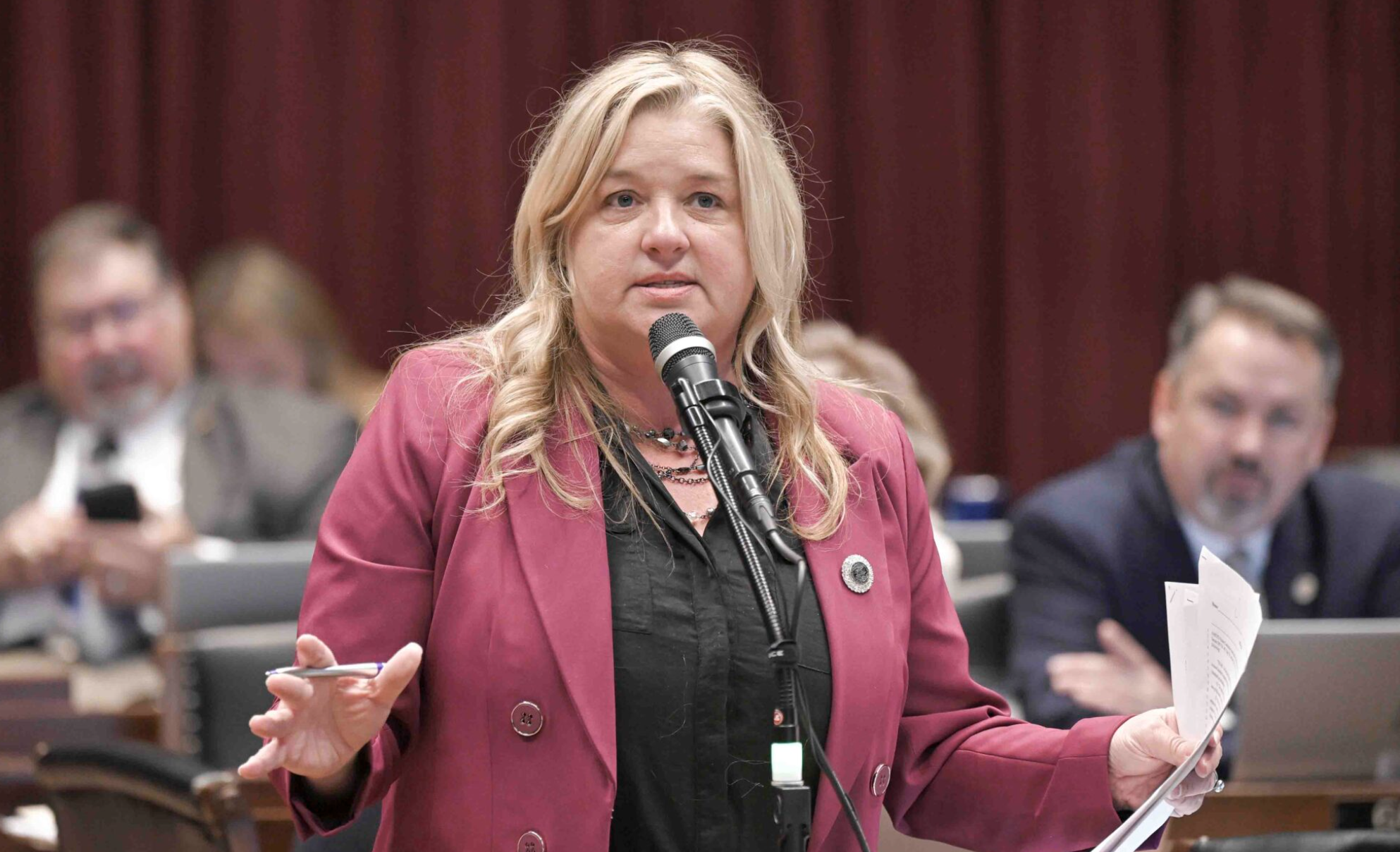
‘This session, we really showed up and offered some exciting wins for Missouri in the space of health care that in prior sessions seemed to be really challenging,’ state Rep. Melanie Stinnett said
By:Steph Quinn and Anna Spoerre
Missouri Independent
The Missouri House gave final approval Thursday to a wide-ranging healthcare bill expanding women’s and maternal health coverage, increasing access to telehealth and requiring licensed childcare facilities to maintain allergy treatment policies.
The House voted 116-21 to send the legislation to Gov. Mike Kehoe in one of its final actions before the end of the legislative session. The Senate passed the bill 26-5 on Wednesday. Republicans were the only members to cast votes against the bill.
Republican state Rep. Tara Peters of Rolla, who sponsored the legislation, is among a handful of lawmakers who for the past four years have been trying, without success, to pass provisions included in the bill. On Thursday, she won her battle.
“There’s a lot of things in the state of Missouri that we focus on,” Peters told The Independent. “And healthcare is something that literally affects every single person.”
One measure proposed by Peters for years would allow women with private insurance to pick up an annual supply of contraceptives rather than going to the pharmacy every few months. This policy is already the law in a majority of states. Studies show this increase in access and continuity can help prevent unintended pregnancy.
The bill also requires insurance to cover blood pressure monitoring equipment for pregnant and postpartum mothers.
Another provision would prohibit discriminatory drug reimbursement practices against hospitals participating in the federal 340B program. The program requires drug manufacturers participating in Medicaid to sell drugs at a discount to nonprofit hospitals serving uninsured and low-income patients.
The bill would also require the Missouri Department of Health and Senior Services to report and track cases of alpha-gal syndrome, a tick-borne allergy to mammal products that can be life-threatening. A Senate amendment seeking to address privacy concerns would limit disclosure of blood test results to patients and their doctors.
An earlier version of the bill would have required the Missouri Department of Social Services to request federal permission to set up a “Food is Medicine” program to help Medicaid recipients access nutrition services and healthy food prescribed by a medical professional. The legislation that passed Thursday would make that program optional.
The Senate removed several provisions after a handful of lawmakers argued at length this week that measures added to the 177-page bill would increase health insurance costs and cause government overreach.
One measure removed from the bill would have barred insurance companies from denying coverage of a prescribed non-opioid drug in favor of an opioid.
Republican state Sen. Travis Fitzwater of Holts Summit said the provision could save costs by preventing opioid addiction.
“You may be able to make the case in a silo that it may or may not increase costs,” Fitzwater said. “But on the back end, [the benefit] shifts towards us when people aren’t going into addiction programs or aren’t going into prisons and moms aren’t dying as a result of not being able to track their blood pressure.”
Maternal health
On average, around 70 women die each year in Missouri during childbirth or in the first year postpartum. Of those deaths, 80% were deemed preventable by the state.
In Missouri, the health department’s Pregnancy-Associated Mortality Review Board tracks maternal health outcomes. An amendment to the bill, filed by state Sen. Barbara Washington, a Kansas City Democrat, expands the board’s duties to include studying the state’s maternal healthcare deserts, tracking the level of prenatal and postnatal care given to women who die in childbirth or postpartum and making recommendations to combat racial inequities in maternal deaths.
In Missouri, babies and mothers continue to die at higher rates than the national average, according to the March of Dimes.
The bill requires insurance to cover home blood pressure monitoring devices for women who are pregnant or in the 12-month postpartum period.
“It’s a great day for private insurance to have to pay for those and help some of our pregnant women with hypertension,” Peters said.
Cardiovascular disease, including hypertension, is among the leading causes of pregnancy-related underlying causes of deaths in Missouri, according to the Missouri Pregnancy-Associated Mortality Review Board.
Doulas have increasingly been cited as part of the solution to Missouri’s poor maternal and infant birth outcomes. The legislation expands doula services for low-income families enrolled in the state’s Medicaid program from six to 16 visits covering pregnancy, birth, postpartum and lactation support.
Doulas do not deliver babies, but rather advocate for the emotional and physical wellbeing of families and can help connect them with other resources.
The bill also expands insurance coverage through Show-Me Healthy Babies, the state’s Medicaid program for pregnancy and postpartum, to include childbirth education classes.
PBM restrictions removed from bill
The Senate removed a series of proposed restrictions on pharmacy benefit managers, or PBMs, which administer prescription drug plans for insurers.
Critics of PBMs argue they have become too closely integrated with insurance companies and national pharmacy chains, giving preferential pricing to certain pharmacies while reimbursing independent and family-owned pharmacies below the prices they pay drug companies for medication.
The measures removed from the bill, part of legislation sponsored by Republican state Sen. Jill Carter of Granby, would have limited when and how PBMs can audit pharmacies and required PBMs to reimburse pharmacies according to the prevailing market value of medications.
Senate Minority Leader Doug Beck, an Affton Democrat, accused those in support of the amendment of backtracking on negotiated language and threatened to block discussion of any proposed changes in future years.
“There was a deal that was made, as you know, and there’s language that was acceptable [to] everybody, and then that language got pulled,” Beck said. “So what I’m going to say is…for the next two years, there’s going to be no PBM stuff going through this chamber. I’m tired of talking about the subject.”
Moving the needle
Republican state Rep. Melanie Stinnett of Springfield, who chairs the House Health and Mental Health Committee and sponsored some of the measures in the bill, told The Independent that the legislation is an example of what bipartisan collaboration can accomplish.
“This session, we really showed up and offered some exciting wins for Missouri in the space of health care that in prior sessions seemed to be really challenging,” Stinnett said. “So I think that when we all sit down and get together and figure out what that looks like, what we need to really move forward, then that can be accomplished.”
While lawmakers made some compromises, Stinnett said they also scored a lot of wins.
“We didn’t get everything we wanted,” Stinnett said, “but we moved the needle.”