


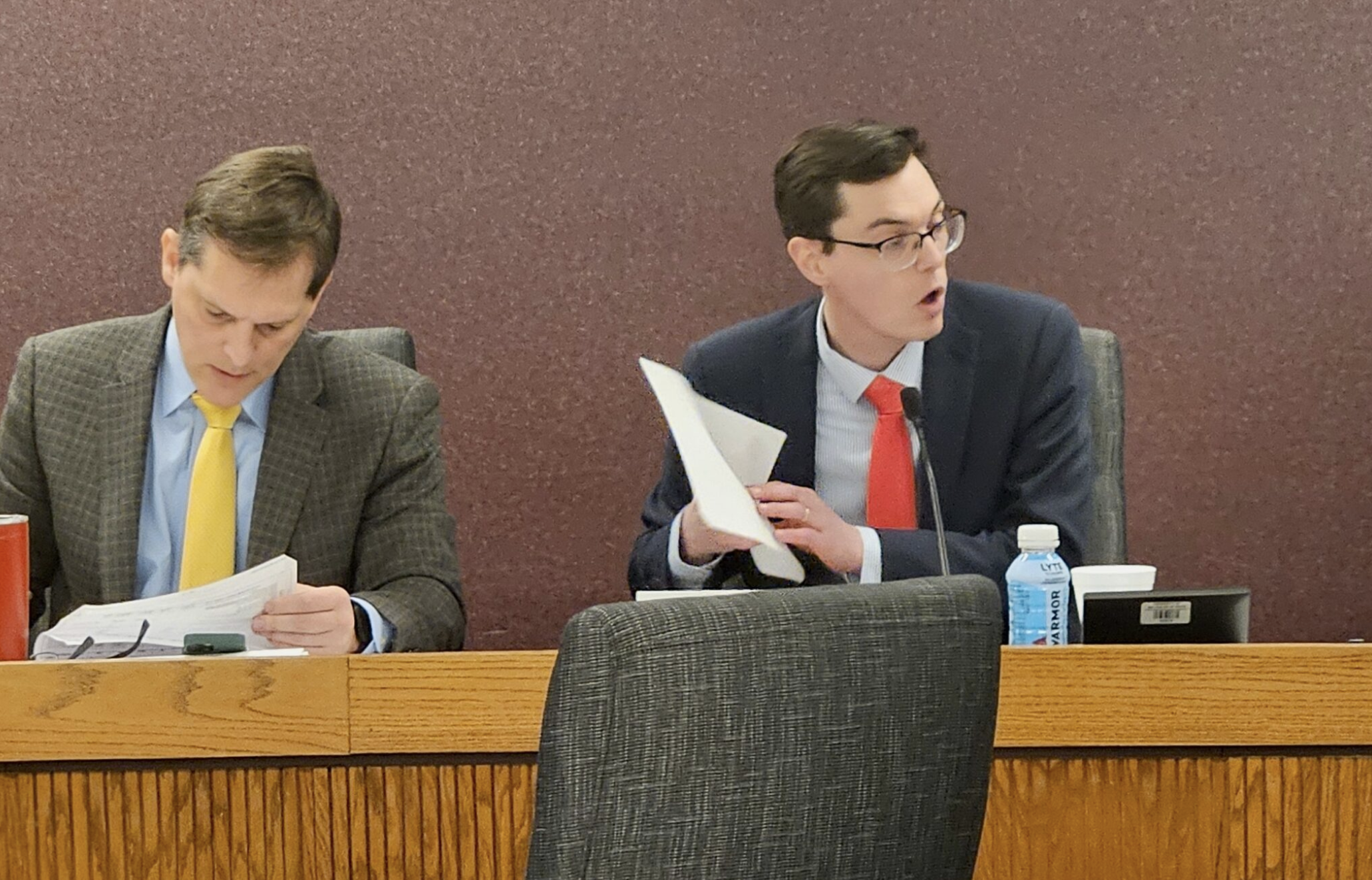
The proposal would base funding on the number of students enrolled and some state schools could lose 40% or more of their state support. The plan is part of a budget proposal that cuts $300 million from general revenue spending requested by Gov. Mike Kehoe
BY: RUDI KELLER
Missouri Independent
A push to shift hundreds of millions of dollars among Missouri state colleges and universities ran into bipartisan skepticism Monday during a hearing of the House Budget Committee.
State Rep. Dirk Deaton, chairman of the House Budget Committee, said he wants to overhaul state support for community colleges and universities by reallocating funding based on the number of full-time students on each campus. Current funding is too tied to past appropriations, he said, and gives the 10 four-year universities and 12 community colleges widely varying amounts for each student educated.
“The money follows the student, it is really as simple as that,” said Deaton, a Republican from Seneca.
State Rep. Ed Lewis, a Moberly Republican, was among members skeptical about the massive reallocation. Truman State University in Kirksville would lose more than half of its funding under Deaton’s plan.
“That would be a tremendous hit to that university, and would probably cause that university to close within two years,” said Lewis, who is a candidate for state Senate in the district that includes Kirksville.
Deaton led the committee through a discussion Monday of his proposed changes to appropriations for state government operations in the coming year. The committee will meet again Wednesday for further changes before sending the 12 spending bills to the full House for debate.
Budget figures compiled by The Independent show the proposals Deaton discussed Monday would use $15.4 billion of general revenue, about $420 million less than Gov. Mike Kehoe requested in January. All spending on operations, including federal funds and earmarked taxes, would be $50.6 billion, or about $1.4 billion less than requested by Kehoe.
Some of the money cut from operations will be shifted to the capital construction budget. Deaton said his spending plan, overall, uses about $300 million less general revenue than the $16.2 billion total sought by Kehoe.
He said he will unveil his proposals for building construction and major renovations after lawmakers return from next week’s legislative Spring Break.
The budget still leaves a huge gap between anticipated revenue and proposed spending. For the coming year, that gap of about $2.6 billion would be covered by accumulated surpluses.
One way Deaton saves general revenue is by tapping other funds that can be spent instead of general revenue. He’s using a constitutional directive to take $64.7 million from the Blind Pension Fund for public schools and taking interest earned since lawmakers set aside $1.6 billion for highway projects on Interstate 70 and Interstate 44, about $160 million total.
Other significant items in Deaton’s budget proposal include:
- Reversing Kehoe’s proposed cuts to services for people with developmental disabilities. Kehoe wanted to cut $6.2 million in state spending for a program allowing individuals with disabilities or their families to hire and train specialized care staff, plus $21.9 million in general revenue funding from structured group day programs, with lost federal funding bringing the total to $80.7 million.
- Barring the state from paying child care providers based on enrollment and sending checks at the beginning of each month. The Department of Elementary and Secondary Education was preparing to launch those changes, from paying based on attendance and paying at the end of the month, in May.
- Keeping a $250,000 allocation, split between general revenue and federal welfare funds, for a grant to the 57 Foundation, set up in late 2024 to “educate the public on the history of Gov. (Mike) Parson’s life and administration.”
Deaton’s proposals for higher education funding shift about $250 million among four-year universities and $26 million among two-year community colleges.
Deaton said he’s not spending any more than Kehoe requested but by changing the method for its distribution, he makes big winners and losers within that limit.
The state’s largest institution, the four-campus University of Missouri System, would receive $542.2 million, up from the $521 million in Kehoe’s budget. The second-largest, Missouri State University, would receive $145.2 million, up from $115.7 million.
Meanwhile, Truman State University would see its funding cut by more than half, to $23.8 million from $50.9 million. Harris-Stowe State University and Lincoln University, the four-year schools receiving the smallest current amounts would each have their core funding cut by almost 40%.
There is no political favoritism being shown in the funding overhaul, Deaton said. He noted that Missouri Southern State University in Joplin near his southwest Missouri district would see a cut.
Missouri’s Southern’s allocation would be reduced by about $6.4 million, to $25.3 million.
“I wish it were different but they do a little bit worse under this plan than their current core model,” Deaton said.
Missouri State and Ozarks Technical College in Springfield would both receive funding boosts, but state Rep. Betsy Fogle of Springfield, the ranking Democrat on the budget committee, said she isn’t satisfied the change is equitable.
“That makes me happy, to see Missouri State getting additional investments and Ozark Technical College getting additional investments,” Fogle said. “But I do have significant concerns with how this will impact my students to go to other public universities and community colleges throughout the state.”
Some lawmakers were enthusiastic in their support of changing how higher education is funded.
“We have subsidized really bad decisions for a very long time,” said state Rep. Louis Riggs, a Hannibal Republican.
But many members were concerned that they have been asked to vote for major building projects and new programs in recent years. The schools need the money to operate those buildings and programs, they said, asking if Deaton would agree to a phased switch.
“Is this something that we just cut the puppy dog’s tail off right away,” asked state Rep. Cathy Jo Loy, a Carthage Republican, “or snip it off a little bit of time?”